
Over a year ago, in early May of 2023, I wrote an article about an interesting firm by the name of IDEX Corporation (NYSE:IEX). For those not familiar with the enterprise, it is a business with a market capitalization of $15.07 billion. Management has built up the company over the years by focusing on highly engineered products such as the production of fluid and metering technologies, products in the health and science fields, fire and safety products, and more. Much of the business even centers around the sale of pumps, ceiling solutions, and similar offerings.
Normally, this is the kind of company that I would be drawn to. Odd little businesses that many would describe to be boring are, to me, amongst some of the most interesting opportunities that exist. Having said that, in that article, I rated the company a ‘hold’. This was in spite of some rather attractive growth that management had been logging. The primary reason for this neutral stance was that, in spite of growth, shares of the enterprise were trading at rather high levels.
Fast forward to today, and I don’t think much has changed. The biggest thing is that shares have drastically underperformed the broader market. While the S&P 500 is up a whopping 31.7%, shares of IDEX Corporation have seen downside of 1.6%. For this year, things are likely to be slightly positive compared to where they were in 2023. But this doesn’t justify an upgrade at this time.
Still pricey
A lot has transpired since I last wrote about IDEX Corporation last year. At that time, we only had data covering the first quarter of 2023. Today, results now cover the first quarter of 2024. For the 2023 fiscal year, the picture for the business was somewhat positive on the top line. Revenue managed to grow by 2.9% year over year, rising from $3.18 billion to $3.27 billion. Unfortunately, this increase came in spite of a 3% drop in organic sales and in spite of a 1% decline involving the acceleration of previously deferred revenue because of the company’s decision to exit the COVID-19 testing application market. Fortunately, the firm did manage to benefit to the tune of 5% from an increase in acquisition activities.
Author – SEC EDGAR Data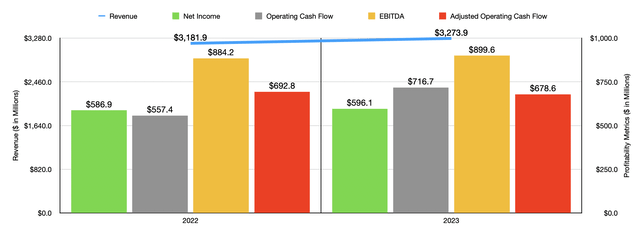
On the bottom line, things improved as well. Net income inched up from $586.9 million to $596.1 million. This was not the only profitability metric to improve. Based on the data provided, operating cash flow expanded from $557.4 million to $716.7 million. If we adjust for changes in working capital, the exact opposite occurred, with the metric pulling back from $692.8 million to $678.6 million. Meanwhile, EBITDA for the business managed to climb from $884.2 million to $899.6 million.
Moving into the 2024 fiscal year, we did see some unfortunate weakening. For the first quarter, revenue dropped a rather hefty 5.3% from $845.4 million to $800.5 million. This was driven by a 6% decline in organic sales, with acquisitions helping to offset this only marginally. On the organic sales side of things, management attributed this to lower volumes involving the company’s Health & Science Technologies operations. Most of the pain occurred in the international market, with revenue there dropping by about 6% while sales domestically dipped a more modest 4%. Given that roughly half of the company’s revenue comes from its international markets, changes on that front can be either really painful or really positive, depending on the outcome.
Author – SEC EDGAR Data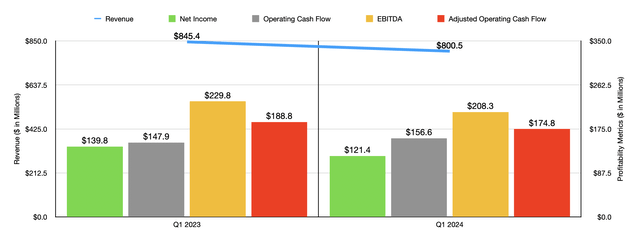
With revenue falling, it should not be surprising to see profitability weaken. Net income fell from $139.8 million to $121.4 million. Obviously, the drop in sales did not help. However, the business did face issues elsewhere also. The firm’s gross profit margin, for instance, dipped from 45.2% to 44.6%. On top of this, selling, general, and administrative costs managed to rise from 22.4% of sales to 24.4%. The worsening of the company’s gross profit margin can really be attributed to lower volume leverage and higher employee related costs. On the selling, general, and administrative side, the company was hit by a $3.5 million cost stemming from acquisition activities. So the firm should, at least in this regard, get a bit of slack.
Other profitability metrics largely followed suit. The one exception to this happened to be operating cash flow. Year over year, it rose from $147.9 million to $156.6 million. If we adjust for changes in working capital, we get a decline from $188.8 million to $174.8 million. Meanwhile, EBITDA for the business contracted from $229.8 million to $208.3 million.
Despite the troubles the business experienced in the first quarter of this year, management does seem optimistic. They expect organic revenue this year to grow by as much as 2%. Though at the low end, they do see it remaining flat. More importantly, if we take the midpoint of guidance for adjusted net income, that would translate to a reading this year of $630 million. By comparison, in 2023, adjusted net profits totaled $623.6 million.
Author – SEC EDGAR Data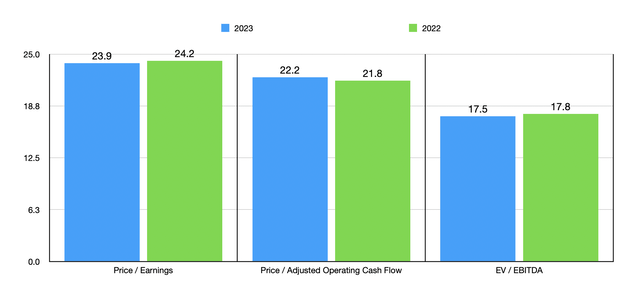
Normally, I would like to see how shares look on a forward basis as well. But this guidance provided by management puts earnings so close to what the company generated in 2023 that I think it would just make more sense to value the business based on those 2023 figures. In the chart above, I did just that, including for reference valuation figures based on results from 2022. I would make the case that shares do look quite lofty here. But relative to similar firms, IDEX Corporation does appear to be around the middle of the group. In the table below, I compared it with five similar enterprises. On a price to earnings basis, only two of the five were cheaper than it. This number rose to three of the five when looking at the picture through the lens of the price to operating cash flow multiple. And lastly, the EV to EBITDA approach results in only one of the five companies being cheaper than our candidate.
| Company | Price / Earnings | Price / Operating Cash Flow | EV / EBITDA |
| IDEX Corporation | 23.9 | 22.2 | 17.5 |
| Xylem (XYL) | 47.5 | 33.7 | 27.1 |
| Dover (DOV) | 17.1 | 19.9 | 12.3 |
| Nordson (NDSN) | 27.4 | 20.5 | 17.9 |
| Stanley Black & Decker (SWK) | 16.5 | 11.7 | 19.9 |
| Ingersoll Rand (IR) | 45.3 | 27.2 | 22.0 |
When focused on the long run, it’s important to be mindful of the overall strategy that IDEX Corporation is implementing. The company’s goal is not to become a player with significant competition. Rather, it intends to remain a firm that’s focused on small, specialized market segments. In its latest investor presentation, for instance, management specified that it targets niche application market opportunities that are smaller than $1.5 billion in size. This helps to exclude major competitors and reduces the likelihood of something the company is working on becoming commoditized. The firm has other standards as well, including making sure that its manufacturing model remains asset light and that technology requires minimal research and development while simultaneously being defensible.
IDEX Corporation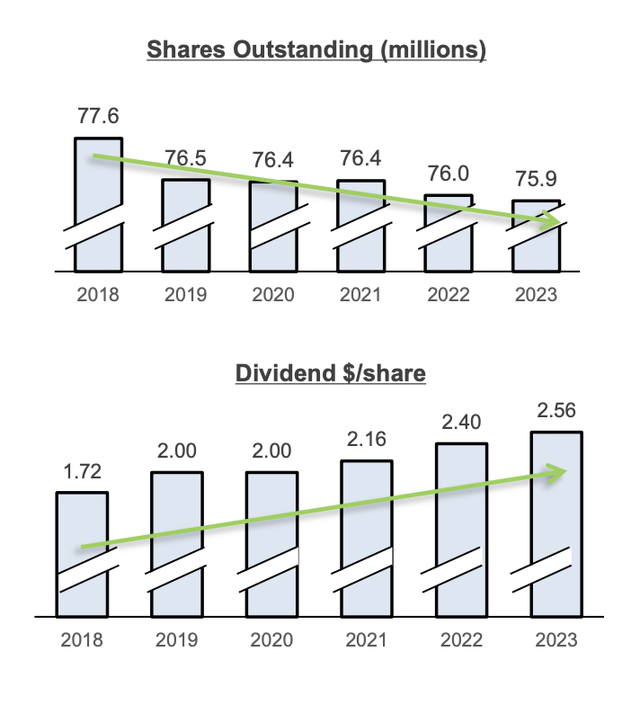
The end goal here is to create a decent sized business with multiple extremely valuable units underneath it. To date, management has achieved just that. However, this has not stopped the firm from placing its focus on other things as well. While investing in these unique market opportunities, the firm has also engaged in share buybacks and has been active in boosting its distribution. Back in 2018, the firm had 77.6 million shares outstanding. That number as of the end of last year was 75.9 million. That’s a decline of 2.2%. Over the same window of time, the company has boosted its dividend per share by 48.8% from $1.72 to $2.56. This seems to be a good mix between investing in unique growth opportunities and returning capital to shareholders that most investors can appreciate.
Takeaway
Despite the problems that IDEX Corporation has faced recently, there is no doubt in my mind that management has built a high-quality business. The overall fundamental health of the company remains robust, and the long-term picture will probably be positive. Having said that, this does mean lower growth opportunities and shares are far from being attractively priced. Given the overall pricing of the business, both on an absolute basis and relative to similar firms, I have to say that this makes for a better ‘hold’ prospect than a ‘buy’ prospect.
Read the full article here