
When many hear the name Moody’s Corporation (NYSE:MCO), they usually think about a firm with a business model confined to ventures with a select few private sector firms. However, there’s much more to the firm than that. In fact, Moody’s is extending its reach to most corners of the world with a comprehensive business model spanning credit ratings and an analytics platform, among other components.
Our analysis here communicates some of our latest findings of Moody’s cyclical and secular prospects. Let’s get started.
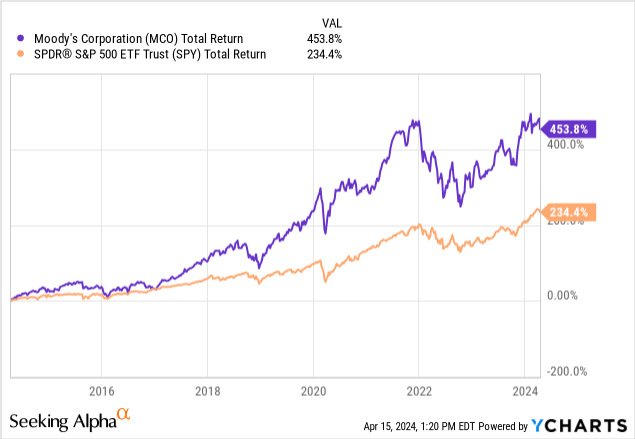
Fundamental Research
Moody’s Rating Business Is Perfectly Positioned
Moody’s Investor Services provides ratings of corporate and government-issued debt. The segment contributes to more than half of Moody’s revenue mix, meaning its performance is pivotal to Moody’s Corporation’s stock performance.
The diagram below delineates Moody’s segmental revenue.
Moody’s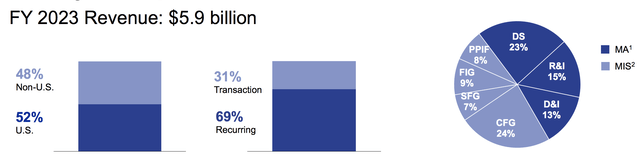
Moody’s Corporation’s fourth-quarter results settled below expectations as the firm suffered an earnings-per-share target miss of 13 cents. However, we spotted a few positives within the firm’s quarterly results, which we think will resume in the coming quarters.
Moody’s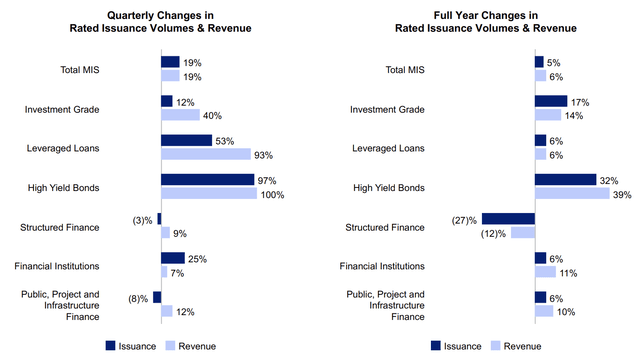
Why do we believe that Moody’s Corporation’s MIS segment is set for better days?
Firstly, we think the global interest rate outlook for the remainder of 2024 and early to mid-2025 will be lower as inflation abates. Sure, as shown by the U.S. March CPI report, we still see situations occur, such as higher-than-anticipated interim inflation in the United States; however, the year-over-year trendline of global inflation is lower, and we think such a trend will continue due to the natural economic cycle.
Aside: Here’s a third-party reference to the interest rate outlook. Click on this link.
Lower interest rates will likely result in higher investment-grade corporate issuance because high-quality firms will likely be able to lower their capital cost via debt issuances. Moody’s already experienced higher investment-grade corporate issuance business in Q4, with volumes ticking up by 12% and revenues by 13%.
Furthermore, as illustrated by the diagram below, Refinitiv, Green Street Advisors, and S&P Global (SPGI) forecast that international public finance issuance will increase for the full year of 2024. We concur as we think lower interest rates and potentially contracting economies on federal and municipal/state levels will coalesce, leading to higher issuance volumes. This could be a significant contributor moving forward.
S&P Global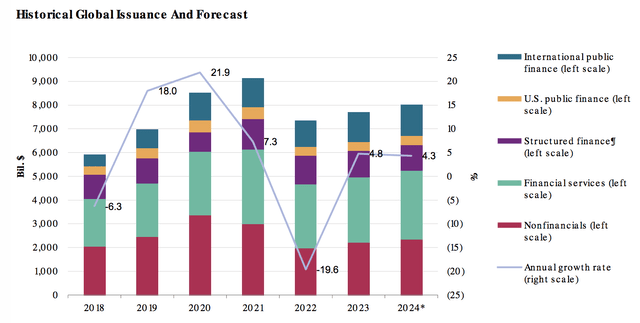
The big elephant in the room is high-yield issuance. Moody’s Corporation’s high-yield bond issuance deal flow and revenue ticked up by 97% and 100% apiece in Q4, suggesting much of its business derived from the junk bond space. Many, including ourselves, fear that credit spreads could spike when interest rates pivot, leading to higher yields on junk debt and lower willingness to issue. However, S&P Global’s sample data suggests lower option-adjusted spreads are forecasted for the remainder of 2024, lending the high-yield space roam to run into.
S&P Global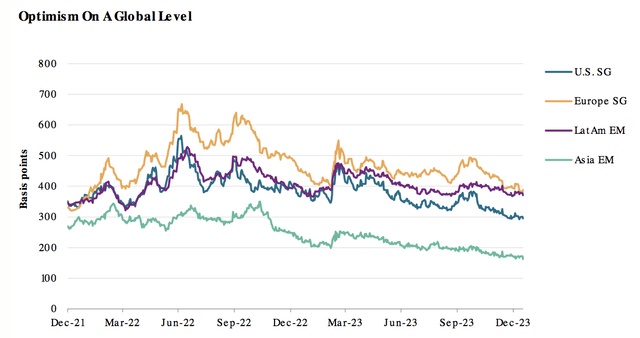
Secular Tailwinds From Analytics
Moody’s Corporation’s ratings business embodies sustainability. However, we think Moody’s Corporations’ analytics segment is where its secular growth is embedded.
I inserted a chart below illustrating Moody’s Analytics’ different functions. It’s impossible to explain each function in an article of around 1,500 words. As such, I’ll summarize the segment this way: Moody’s Analytics is a non-ratings business providing platforms, bodies of knowledge, and data to end clients interested in credit ratings. It’s a vertically integrated segment that aligns with modern asset management and assists interested parties with their decision-making processes.
Moody’s Analytics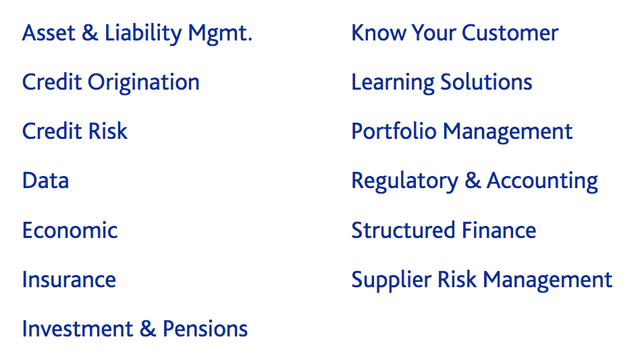
Moody’s Corporation’s decision solutions added $361 million in Q4 revenue, a 10% year-over-year increase. We see tremendous potential in this offering as it provides clients with the necessary risk-based decision tools (such as scenario analysis), which folds into the ever-growing quantitative investment management landscape.
Furthermore, Moody’s Q4 data & information revenue increased by 14% year-over-year to $205 million. This segment folds into the aforementioned decision-making segment as it feeds the segment’s data. Moreover, the segment stretches beyond to deliver scarce data to end clients. Our optimism here stems from the difficulty of obtaining data from certain locations such as emerging markets, frontier markets, and thinly traded corporate debt markets – Moody’s has the necessary means to tap into these areas and offer its clients the necessary data.
As for research and insights, we don’t see a significant competitive advantage here, but pockets such as ESG research can add sustainable revenue in the future.
Moody’s Analytics Revenue (Moody’s)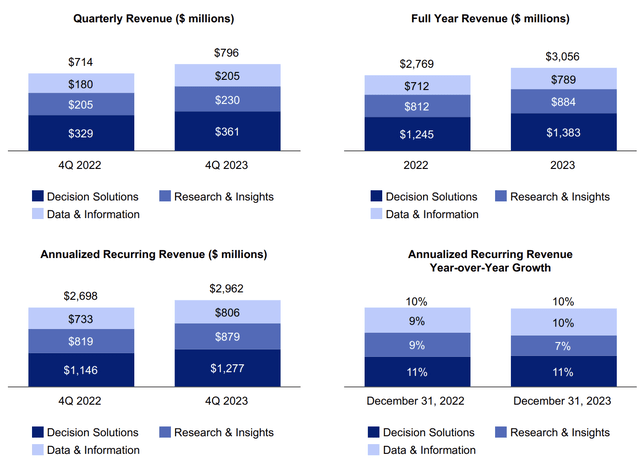
Lastly, I wanted to phase in an anecdotal opinion: Money management and financial research are being democratized. The arena is much more scattered than a few decades ago, and therefore, Moody’s Corporation’s deal flow isn’t merely confined to large financial institutions. Moody’s Analytics will play a critical role in the continuous fragmentation with likely benefits from a broader end-market.
Concentrated Market-Driven Profit Margins
Moody’s credit ratings business operates in a concentrated market. To our knowledge, most companies have their debt rated by three main credit rating agencies: Moody’s, S&P Global, and Fitch. Therefore, the firm operates in a market with exceptionally high barriers to entry, communicated by its 5-year average profit margins in the diagram below.
Seeking Alpha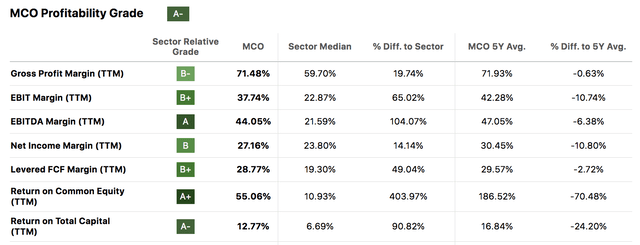
Moody’s Analytics operates in a more competitive market, meaning margin compression is possible. However, the segment provides diversified revenue, allowing Moody’s to smooth its income statements.
A few income-statement-based metrics were collated with a brief discussion following beneath.
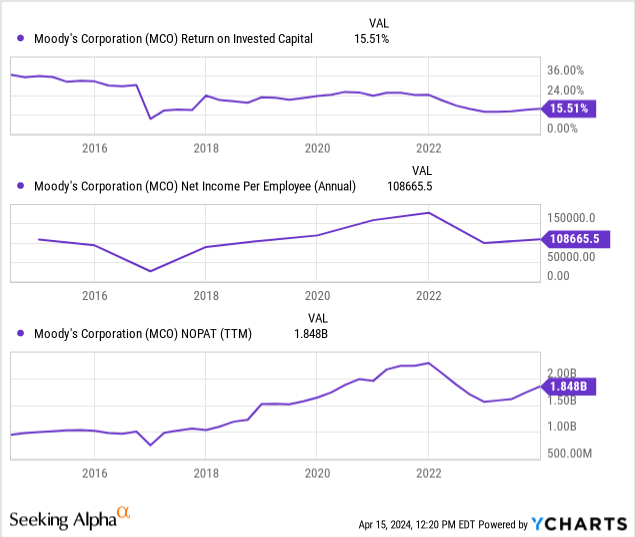
- ROIC: Moody’s high return on invested capital is encouraging, and the ROIC metric is often used to measure a firm’s competitive advantage in an industry. The thought process correlated the amount invested to obtain a profitable market share.
- NOPAT: Growing net operating profit after taxes sometimes communicates continuous value-additivity from management.
- Net income per employee: Lastly, Moody’s has a high net income per employee, conveying the utility gained from each person it employs.
The aforementioned variables are vague, but we think they’re noteworthy indicators.
Valuation and Dividends
A P/E expansion formula was used to value Moody’s Corporation’s stock, as we believe the firm’s maturity and moderate depreciation & amortization allow for a bottom-line valuation. Moreover, Seeking Alpha’s platform provided us with comprehensive earnings-per-share forecasts from leading analysts—up to 19 forecasts per quantile were made available for our given opportunity set.
We decided to focus on a December 2025 price target as the time more-or-less coincides with our fundamental outlook.
Now, is Moody’s stock undervalued? Our interpretation of the P/E expansion formula deems Moody’s stock undervalued. For context, a worst-case scenario results in a price target of $384 (the stock traded at about $378 at the time of authoring this article).
Author’s Work (Seeking Alpha)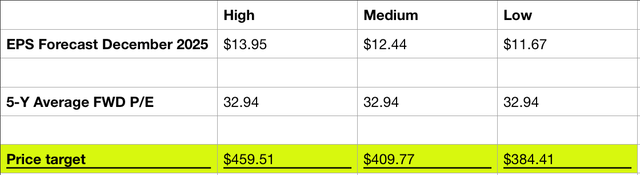
Although our chosen model deems Moody’s stock undervalued, we encourage readers to consider other viewpoints before making their final investment decisions to ensure a holistic analysis. We decided on a single-metric absolute valuation, but our point of view isn’t necessarily correct.
Furthermore, we don’t think Moody’s Corporation’s forward dividend yield of 0.9% is compelling, nor do we think it adds a floor to Moody’s stock price. As such, careful consideration must be given to the stock’s true valuation.
Seeking Alpha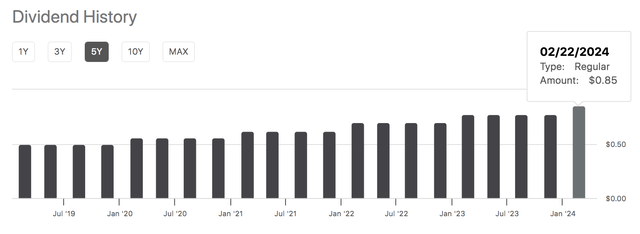
Risks
I’ve been singing Moody’s praises throughout this article. However, it’s time to even matters out by outlining a few risks.
Firstly, a fundamental risk worth considering is deleveraging in critical areas, which could lead to lower deal flow for Moody’s Corporation’s MIS segment. For example, we mentioned earlier that we expect an increase in option-adjusted spreads when interest rates fall due to the natural inverse correlation (between interest rates and OAS). As shown earlier, S&P Global’s forecast disagrees with our outlook, but we maintain the possibility of higher credit spreads, which could lead to lower high-yield issuance.
Illustrating The Credit Vs. Interest Rate Cycle (Analyst Prep)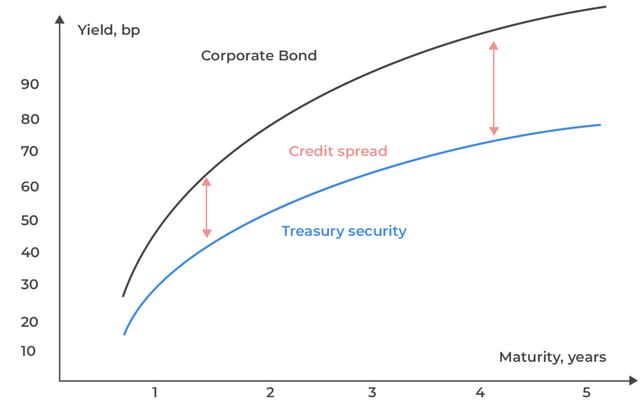
Another deleveraging issue to consider relates to China. Corporate deleveraging has occurred in the past years, and there are no signs of it stopping. China is the world’s second-largest economy and, therefore, a key deal flow provider to Moody’s. Sustained Chinese deleveraging could have a material effect on Moody’s top-line revenue.
Chinese Deleveraging (S&P Global)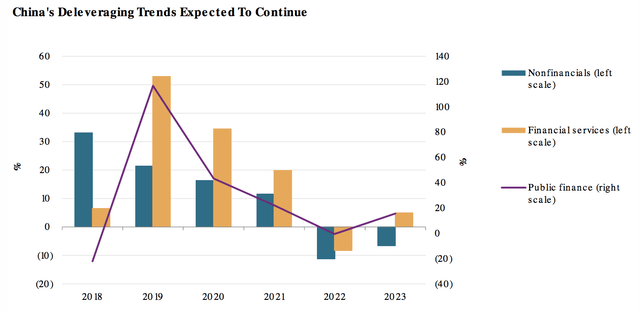
Lastly, we urge readers to consider Moody’s stock’s tail risk. A birds-eye view of Moody’s stock suggests it holds moderate risk, as it has a modest beta coefficient of 1.26. However, a closer look shows that its monthly 5% value-at-risk exceeds the SPDR S&P 500 Trust ETF’s (SPY) by nearly twofold, suggesting that considerable tail risk is embedded in this asset.
YCharts, Seeking Alpha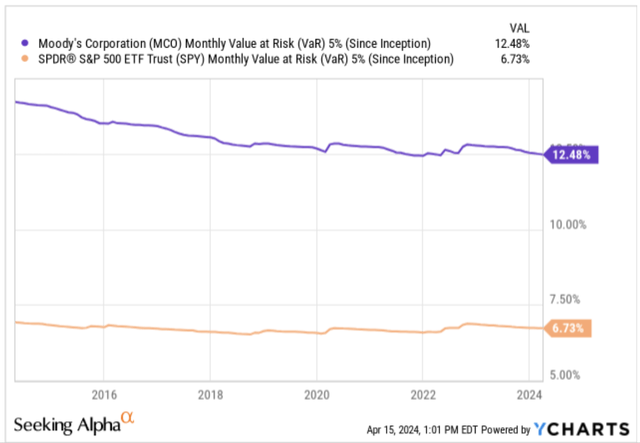
Final Word
Our analysis shows that Moody’s Corporation’s fundamentals are robust. The company’s investor services are positioned to benefit from a pending global interest rate pivot, which would likely lend the firm opportunities in investment-grade and public debt.
Furthermore, Moody’s Analytics adds a secular growth overlay to Moody’s Corporation’s story as its comprehensive offerings are aligned with an increasingly fragmented asset management arena.
Lastly, although other valuation methodologies must be considered, our P/E expansion formula indicates that Moody’s is undervalued.
Consensus: Buy/Market Perform
Read the full article here