Intro
We wrote about Ryder System, Inc. (NYSE:R) back in early January of this year we recommended that investors implement a trailing stop-loss to protect paper gains from any potential unexpected down move. As noted in the commentary & associated technicals, Ryder is not a recession-proof stock thus demonstrated by the performance of stock in the 2008 & 2020 recessions leading to an above-average beta (1.38). However, the wind certainly seems to be in Ryder’s sales at present as growing cash flow continues to lead to strong organic-backed investment surmising sustained fleet growth as well as ongoing growth initiatives.
The attractiveness of Ryder from a long-term bullish standpoint is its valuation, strong double-digit return on equity number, and how the company is favorably positioned for a cycle upturn in all of its segments. When the freight cycle turns remains unknown at this stage but Ryder’s financials demonstrate how the company has transformed itself in recent years through the balanced growth initiative. On the 14th of February this year, Ryder beat earnings estimates for its fourth quarter of fiscal 2024 and delivered solid 2024 guidance despite ongoing adverse trading conditions for used vehicles & rental. Furthermore, taking into account the muted economic & freight-orientated environments, all of the company’s segments are still expected to deliver profitable contractual growth in fiscal 2024
Ryder is also a shareholder-friendly company having returned $460 million to shareholders in fiscal 2023 through the buyback program and dividend payments. Therefore, let’s use a popular discount model to try and stamp a valuation on Ryder to see if indeed the encouraging performance of the logistics and transportation company in this present freight downturn bodes well for future share-price gains.
Dividend Discount Model
The formula we use to value Ryder is the following:
Dividend Discount Model (Wallstreetmojo.com)
EDPS = Expected Dividend Per Share; DCCE = Cost Of Equity; & DGR equates to Dividend Growth Rate
The beauty of this valuation exercise (as opposed to studying independent valuation multiples) is that it uses Ryder’s retention ratio plus its return on equity to gauge what the sustained dividend growth rate will be going forward. Furthermore, risk is also factored into the calculation through the use of the stock’s beta along with comparable fixed-term alternative investments such as the 10-year US bond.
Although the dividend was hiked by 15% in 2023, we calculate the sustained dividend growth rate by multiplying Ryder’s retention ratio by its return on equity. Since the company’s trailing dividend GAAP ratio comes in at 31.5%, this means the retention ratio comes in at 68.5%. Therefore, when we multiply the trailing ROE of 13.45% by 0.685, we get our sustained dividend growth rate of 9.21%. This means our Expected Dividend Growth Rate is the present dividend ($2.84) multiplied by our Dividend Growth Rate of 9.21% to give us $3.10 per share.
Cost Of Equity
To calculate the cost of equity, we use the following formula:
Cost of equity = Risk-Free Rate + (Beta) x (Equity Risk Premium)
We will be using the 10-year US Treasury bond yield as our risk-free rate (4.23%) & Damodaran’s US third-party calculation as our equity risk premium (4.6%). The ‘Cost of equity’ calculation helps us establish the required rate of return investors seek while at the same time encapsulating the absolute minimum return in a long investment in Ryder (equity risk premium).
Plugging our values into the formula, we calculate:
Cost of equity = 4.23% + (1.39)(4.6) = 10.62%
Therefore, when we plug everything back into our above dividend discount formula, we get the following:
Valuation Of Ryder = 3.1 / 0.1062 – 0.0921 = $219 a share
Elevated Investment Continuing Through The Down Cycle
Now, considering Ryder is trading just north of $115 at present, we must ask the question of why our valuation estimate comes in well above $200 a share. To this point, sustained contractual growth and high ROE amid a freight downturn are solid precursors to why a high valuation has been forthcoming. Furthermore, all of the company’s operating cash flow is being put to work in both organic & inorganic investments which means the company is primed to grow at an above-average clip when the eventual upturn comes.
Below for example, we see how the recent acquisition of Cardinal Logistics is expected to drive Ryder’s revenues forward through both scale & density to the dedicated business. Cardinal’s footprint is especially prominent on the East Coast, making up 200+ operating locations in the attractive Customized Solution Segment Of Dedicated.
Ryder’s Cardinal Logistics Acquisition (Seeking Alpha)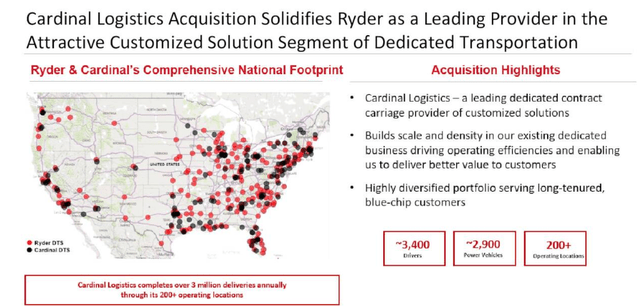
With the above acquisition being realized in the first quarter of this year, it will be interesting to see how Ryder’s balance sheet changes as a result. As the purchase price of the deal was not disclosed & leverage as we know is a double-edged sword, it will be interesting to see Ryder’s reported ‘Goodwill’ after the first quarter & how the company’s net debt position has changed accordingly. Ryder’s cash position at the end of Q4 came in at $204 million.
Therefore, for the moment, we are going to reiterate our ‘Hold’ rating in Ryder until further developments. As we can see from Ryder’s technical chart below, shares have not yet been able to take out their late 2023 highs. If indeed an ascending triangle (buyer accumulation) is playing itself out here, there will be plenty of upside available to investors if an upside breakout presents itself. Remember, the technicals must be aligned with the fundamentals of the company for us to upgrade the stock to a Buy.
Ryder Technical Chart (Stockcharts.com)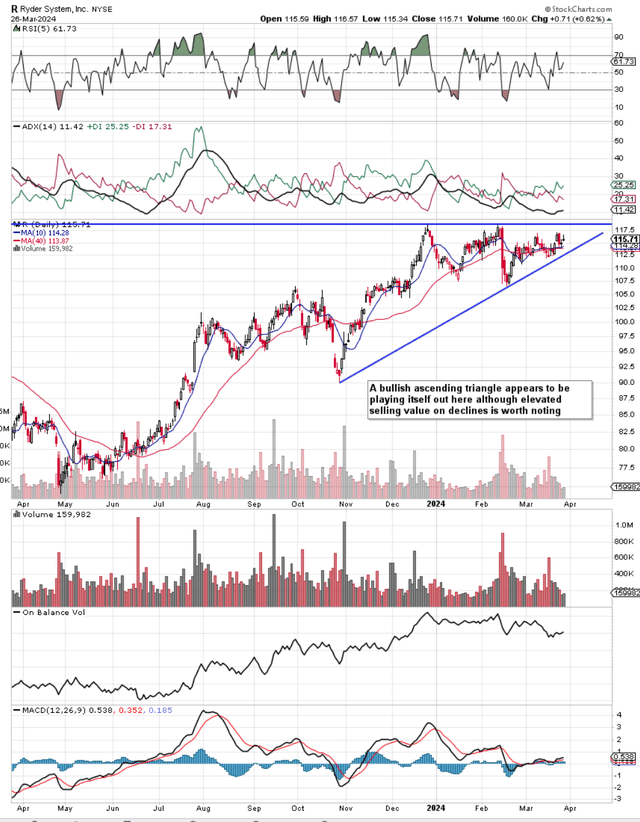
Conclusion
To sum up, taking into account how Ryder’s operations have been outperforming prior cycles & how long-term shareholder value is being consistently created through the balanced growth strategy, it is not surprising to see an attractive valuation stemming from the dividend discount formula. Strong organic & inorganic growth has set up Ryder for strong growth once the cycle turns in earnest. We await however a technical breakout before upgrading the stock. We look forward to continued coverage.
Read the full article here