
Note:
Seadrill Limited (NYSE:SDRL) has been covered by me previously, so investors should view this as an update to my earlier articles on the company.
Three weeks ago, leading offshore driller Seadrill Limited or “Seadrill” reported fourth quarter and full-year 2023 results within the guidance provided by management on the third quarter conference call:
Company Press Releases / Conference Call Transcripts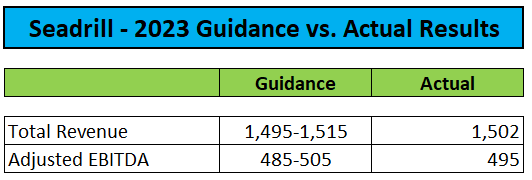
As expected, Adjusted EBITDA margin took a hit in the fourth quarter as operating expenses increased by approximately 17% sequentially due to a combination of higher non-cash accruals, planned maintenance projects, and related spare parts purchases as well as increased personnel expense, including severance costs:
Regulatory Filings / Press Releases
Seadrill reported total operating revenue of $408 million which consisted of contract drilling revenue of $315 million, joint venture management revenue of $73 million, reimbursable revenue of $6 million, and $14 million of other revenue including bareboat charter income from three jackup rigs leased to Gulfdrill, the company’s 50:50 joint venture with Gulf Drilling International in Qatar.
Contract drilling revenues were impacted by “unplanned downtime related to well control equipment” thus resulting in mediocre revenue efficiency of 92.4%. In addition, the semi-submersible rig Sevan Louisiana finished a well-based contract earlier than anticipated. The weaker contract drilling performance was offset by higher management fees from Sonadrill, the company’s 50:50 joint venture with Sonangol in Angola.
Seadrill generated $140 million in cash flow from operating activities and $92 million in free cash flow. The company finished the quarter with just under $700 million in unrestricted cash and cash equivalents and $625 million in debt.
However, total cash and cash equivalents were down by approximately $141 million on a sequential basis as the company executed on a $250 million share buyback program which was completed late in the quarter. Subsequently, Seadrill authorized a new $250 million buyback program, of which $117.3 million has been utilized to date. The company continues to be in the market basically every trading session at an average weekly repurchase run rate of approximately $10 million. Seadrill reports on its buyback progress in SEC filing once a week.
Backlog of $2.9 billion was up by approximately $600 million on a sequential basis mostly due to the recently announced long-term contract awards for the drillships West Auriga and West Polaris in Brazil.
On the conference call, management outlined its expectations for 2024 being a year of transition for Seadrill with elevated out-of-service time resulting from a heavy special periodic survey (“SPS”) schedule and material contract preparation requirements for West Auriga and West Polaris.
In addition, the harsh environment semi-submersible rig West Phoenix will roll off contract in August and subsequently undergo a shipyard stay for upgrades, maintenance, and work related to regulatory compliance. Management expects the rig to remain idle until at least Q2/2025 as North Sea drilling programs usually don’t start before spring.
Consequently, the company expects full-year revenues to be approximately flat with an up to 25% reduction in profitability and capital expenditures basically doubling from 2023 levels:
Conference Call Transcript
Please note that Seadrill’s capex guidance also includes maintenance costs which run through the P&L statement and have already been accounted for in the company’s Adjusted EBITDA projections.
Seadrill’s contract coverage for 2024 is approximately 80% thus leaving 39 months of uncontracted rig time for this year. However, management expects an aggregate 17 months of contract preparation for West Auriga and West Polaris and another seven months to complete special periodic surveys and related maintenance on five rigs.
With just 15 months of effectively available rig time left, potential revenue upside for 2024 appears very limited.
While the recent lull in contracting activity has unsettled market participants, the issue has been widely attributed to customers shifting towards more long-term contracts and associated greater lead times thus resulting in some misalignment between demand and rigs coming off contract this year.
Consequently, the book-to-bill ratio for floating rigs has decreased quite meaningfully in recent quarters while the average contract duration continued to move up:
Pareto Securities
In addition, the market has experienced a steady influx of previously sidelined floater capacity as a number of cold-stacked drillships and stranded newbuilds in shipyards have been awarded long-term contracts at sufficient rates.
While the combination of temporarily weaker demand and higher supply has seemingly put a lid on dayrates in recent quarters, all industry players expect the recent hiccup to be short-lived with dayrates anticipated to resume their upward trajectory going into next year.
With tendering activity for floating rigs at multi-year highs, I strongly agree with this view:
Pareto Securities
Assuming contracting activity picking back up and dayrates remaining at least stable, 2025 should be the year of earnings inflection for all the majority of industry players including Seadrill.
However, the weaker-than-expected operating environment in recent quarters has caused me to take a more conservative approach to my future profitability expectations:
Author’s Estimates
Consequently, I am reducing my price target from $62 to $60 while reiterating my “Buy” rating on the stock.
Author’s Estimates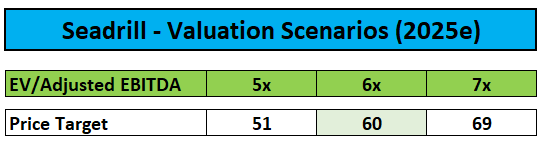
That said, following the recent rally in offshore oil and gas service stocks, I would prefer waiting for a pullback to initiate or add to existing positions.
Author’s Estimates
Key Risk Factor – Oil Price Correlation
Please note that offshore drilling stocks remain heavily correlated to oil prices so any sustained down move in the commodity would almost certainly result in industry shares taking a hit.
Bottom Line
Seadrill reported fourth quarter results and provided 2024 guidance largely in line with expectations. While this year’s financial performance will be impacted by a combination of elevated special survey and contract preparation requirements as well as some idle time for a number of rigs, I still expect 2025 to be a year of major earnings inflection for the company and the industry as a whole.
Consequently, I am reiterating my “Buy” rating on the shares with a slightly reduced price target of $60.
Read the full article here