
Part of my job as a value investor is sifting through financial data from publicly traded firms in order to find some of the best opportunities out there. Over a year ago, I made a concerted effort to focus more on the financial sector. I had always wanted to get more into that space, but the impetus to do so came from the banking crisis that began in March 2023. I have found, since that time, plenty of interesting prospects. Some of these I have been very bullish about. And others, I have been, let’s say, less enthusiastic over.
Unfortunately, one company that falls far short of the optimistic side of the spectrum is Southside Bancshares (NASDAQ:SBSI). With a market capitalization as of this writing of $1.04 billion, the bank is not exactly small. However, it’s far from being large. In recent years, the institution has seen a general increase in the size of deposits. But revenue has been virtually flat, while earnings have pulled back. It would be one thing if shares were attractively priced and if the quality of its assets were at the high end of the spectrum. But neither of these are the case. Given these facts, I have no choice but to rate the business a ‘hold’.
A look at Southside Bancshares
According to the management team at Southside Bancshares, the company traces its roots back to 1960. Compared to many of the other banks that I have seen over the past year or so, this makes this candidate fairly young. Since its inception, the firm has grown to operate 55 branches. 13 of these are located in grocery stores. And through these branches, the company has offered customers a wide array of banking related services. Examples include wealth management and trust services, loan origination activities, brokerage activities, and more.
Management describes Southside Bancshares as a ‘community-focused financial institution’. And as part of its commitment to that description, the firm serves customers that are not only businesses, but also individuals, municipal entities, nonprofit organizations, and more. Loans that it provides include those for single family and multifamily real estate, commercial real estate, equipment, working capital, and more. On the trust and wealth management side of things, the company helps with things like estate administration, custodian services, the setting up of corporate entities, the establishment of trusts, the management of retirement plans, and more. The company focuses its efforts on certain parts of Texas, including East Texas, South Texas, and major metropolitan areas like Dallas-Fort Worth, Austin, and Houston.
Author – SEC EDGAR Data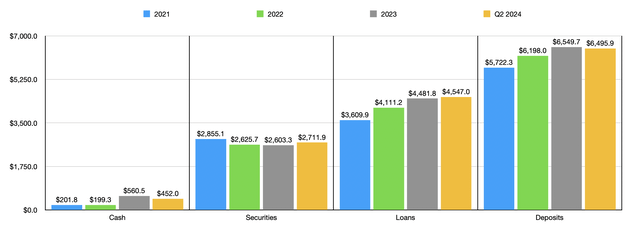
Over the years, Southside Bancshares has seen a pretty steady growth in the value of deposits on its books. These totaled $5.72 billion in 2021. By 2023, they had grown to $6.55 billion. Unfortunately, we did see a slight pullback to roughly $6.50 billion for the second quarter of the 2024 fiscal year. This is not terribly concerning, but investors should pay attention to it. One thing that I don’t like is that uninsured deposit exposure is a bit higher than I would prefer. I typically like to see this number at around 30% or lower. But in the most recent quarter, 36.4% of the company’s deposits were uninsured.
There are, of course, other balance sheet related assets that investors should be paying attention to. Loans would be one such example. Back in 2021, the institution had $3.61 billion worth of loans on its books. These grew to $4.55 billion as of the end of the most recent quarter. The greatest exposure in the loan category that the bank has is to commercial properties. These comprised about $2.47 billion, or 53.9%, of all of the loans on the company’s books. By comparison, the next largest concentration is to family residential properties at $738 million. Loans to individuals account for a paltry $55.7 million.
Author – SEC EDGAR Data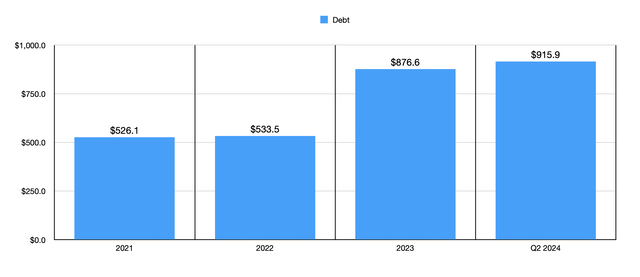
One positive thing about Southside Bancshares is that a good portion of the value of its assets is tied up insecurities. Even though this number dropped from $2.86 billion in 2021 to $2.60 billion at the end of last year, there was an increase to $2.71 billion as of the end of the most recent quarter. Unfortunately, not every metric has improved. The value of cash as of the end of the most recent quarter was only $452 million. This is actually down from the $560.5 million reported at the end of 2023. Fortunately, it is meaningfully higher than what the bank had in both 2021 and 2022. Debt, meanwhile, has been on the rise. From 2021 to 2023, the value of debt on the company’s books exploded from $526.1 million to $876.6 million. And today, that number stands at about $915.9 million.
Author – SEC EDGAR Data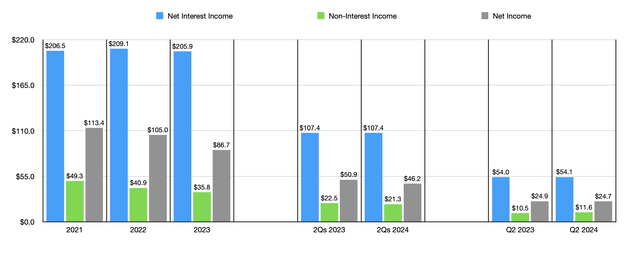
You would think that the gradual increase in the bank’s balance sheet would cause revenue and profits to rise nicely. But that has not been the case. Net interest income has remained in a fairly narrow range over the last three fiscal years. And even for the first half of this year, the $107.4 million that the company generated exactly matched the $107.4 million reported the same time in 2023. This flatlining at a time when the value on the company’s books has increased seems to be largely the result of the firm’s net interest margin contracting from 3.19% to 2.87%. This trend is not surprising to me when you consider that a high interest rate environment like what we have today is causing depositors to look elsewhere for stronger yields. So banks need to compete for those deposits by accepting smaller spreads. We actually saw the same thing from 2022 to 2023 when the net interest margin for the bank dropped from 3.32% to 3.09%.
While net interest income has been mostly flat, non-interest income has only shown signs of weakening up until the second quarter of 2024 when it ticked up from $10.5 million to $11.6 million. From 2021 through 2023, non-interest income declined from $49.3 million to $35.8 million. This has largely been caused by a big swing in gains associated with the sale of available for sale securities. In 2021, The company booked $3.9 million in gains on the sale of available for sale securities. But in 2023, the firm took an almost $16 million hit on them. This, combined with higher costs, mostly associated with a rise in salaries and employee benefits, pushed net profits down from $113.4 million to $86.7 million. And even for the first half of this year, the $46.2 million in income that the bank saw fell short of the $50.9 million reported for the first half of 2023.
Author – SEC EDGAR Data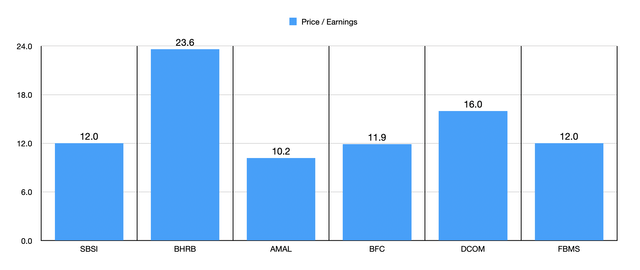
When it comes to valuing the institution, there are a couple of approaches that we can use. The first would be the price to earnings multiple. In the chart above, you can see what this is. You can also see how it stacks up against five similar banks. In this case, Southside Bancshares is smack-dab in the middle, with two of the five firms trading cheaper than it is, while another is tied with it. Another way to look at a bank is relative to book value. And in this case, once again, we have a company that is roughly in the middle of the pack. In the chart below, you can see how Southside Bancshares is valued on a price to book basis and on a price to tangible book basis. Two of the five companies ended up being cheaper than it from a price to book perspective. And three of the five are cheaper from a price to tangible book perspective.
Author – SEC EDGAR Data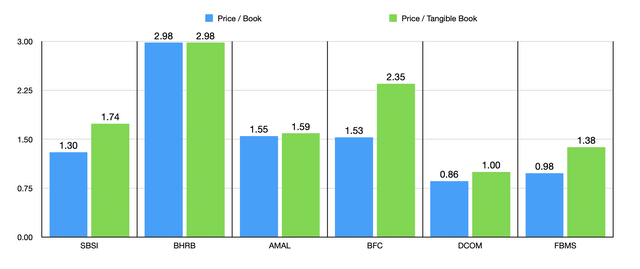
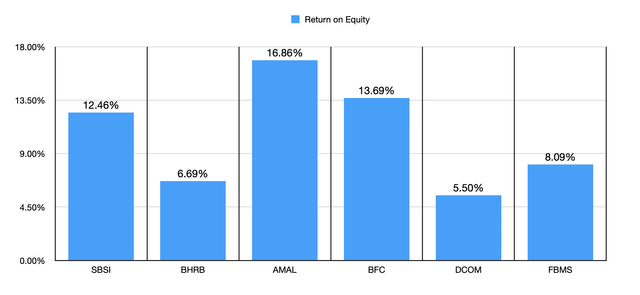
Outside of valuation, we need to look at asset quality. High quality assets can justify a premium, while low quality assets can necessitate a discount. In the first chart below, you can see the return on assets of Southside Bancshares stacked up against the return on assets of the same five companies I valued it against. With a reading of 1.19%, Southside Bancshares is higher than three of the five banks that I compared it to. And in the subsequent chart, you can see the same approach using return on equity. And once again, three of the five companies are lower than our candidate. This means that Southside Bancshares is basically in the middle of the pack.
Author – SEC EDGAR Data Author – SEC EDGAR Data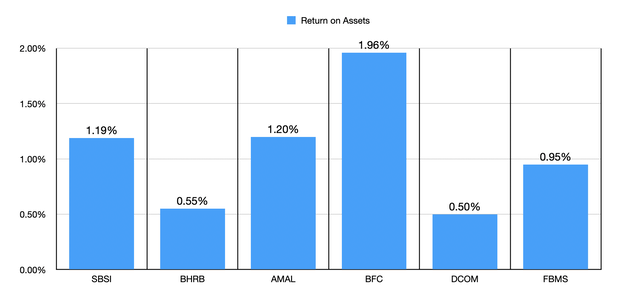
Takeaway
Fundamentally speaking, Southside Bancshares it’s not all that impressive to me. It’s certainly not a bad institution. But it’s not cheap enough, either on an absolute basis or relative to similar firms, to capture my interest more than it has. Asset quality is not bad, but it’s not something that makes the institution special, either. Debt has been rising while cash has pulled back slightly. Deposits have largely increased, but there was a recent downturn there and uninsured deposit exposure is a bit higher than I would like. Add on top of this declining revenue and profits, and I think that a ‘hold’ rating is perfectly appropriate.
Read the full article here