
The iShares 20+ Year Treasury Bond Buywrite Strategy ETF (BATS:TLTW) is designed to give investors exposure to 20-year treasury bonds (US20Y) while jacking up income by writing monthly call options on the underlying. My baseline assumption with these more complicated products is to rather hold the simple version. As of May 24, iShares puts the distribution yield at 11.58% while the 12-month trailing yield added up to 16.61%. The problem with these income-focused products and their enticing yields is that there is usually a risk associated with it.
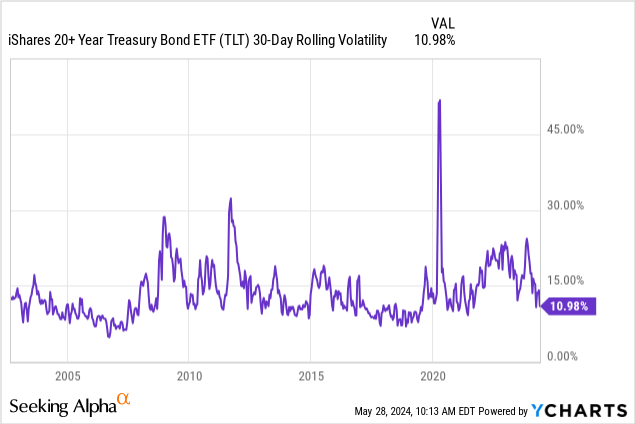
Here that’s the volatility in bond markets, which has been outsized over the last few years. Because this is a product where the upside is sold (through calls) the key risk is that bonds rally tremendously, and you miss out on most of that. Because volatility in bond markets has been receding, the ongoing yield (derived from coupons but mostly from option selling) is coming down at the same time.
In my previous article on TLTW, from February 2024, I said that it’s not clear to me where bonds were going. I still don’t have a strong opinion. I lean towards bond yields going up over the long term.
Being long bonds, with some yield at least, and selling calls seems a very reasonable position to me. Much more sensible than outright long bonds. For now, I think TLTW is a better option than TLT. That won’t be the case forever. If implied volatilities come in, presumably as realized volatility dries up, the call selling will deliver much lower returns. This also means the 16% returns won’t be achieved, even if bonds remain stable, because future call selling will likely be done at lower levels of volatility. At a lower volatility, I’d reconsider whether it is still worth the increased management expense vs. the simpler TLT fund.
TLTW did outperform TLT since then, although neither did well:
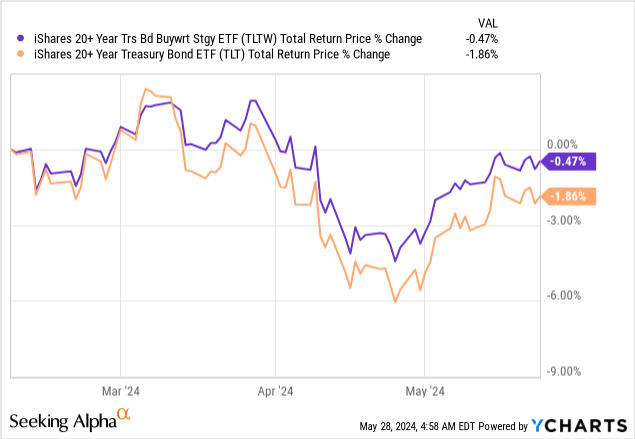
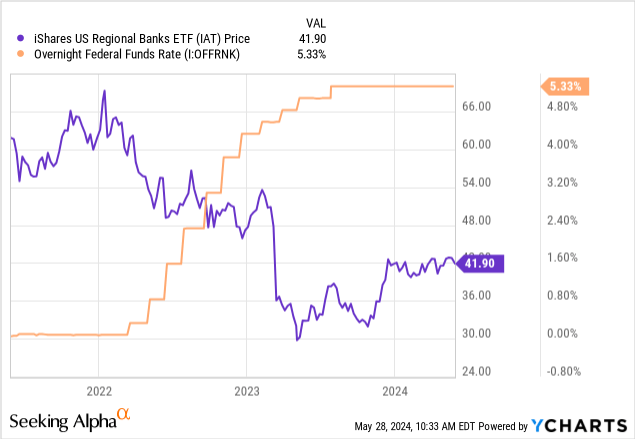
The yield based on current volatility levels is markedly lower than it was back then. At the same time, we’ve had some big moves and the Fed has been clear they aren’t about to cut. Meanwhile, we’re moving into what’s generally a quiet period (i.e., the summer). Importantly, the pending banking crises that followed the rapid rate hike cycle appears to be behind us and regionals are recovering:
Both realized and implied volatility have been coming down:
Back in February, the CME Fedwatch tool illustrated how bond markets were biased towards cuts coming. That has changed, and even rate hikes are under consideration:
CME Fedwatch tool (CME)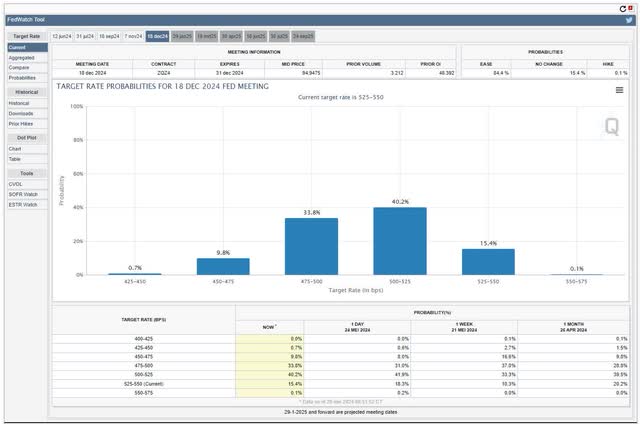
What I like about this more balanced outlook is that if it turns out things are going opposite of the consensus direction, you don’t face a highly volatile move.
The U.S. yield curve remains inverted and has been since July 2022. We’re coming up on two years now. The yield curve is considered a recession signal and has historically been quite successful. On average, recessions follow an inversion within 12 months. But in 2006 it took 22 months before the recession materialized.
U.S. Yieldcurve (worldgovernmentbonds.com)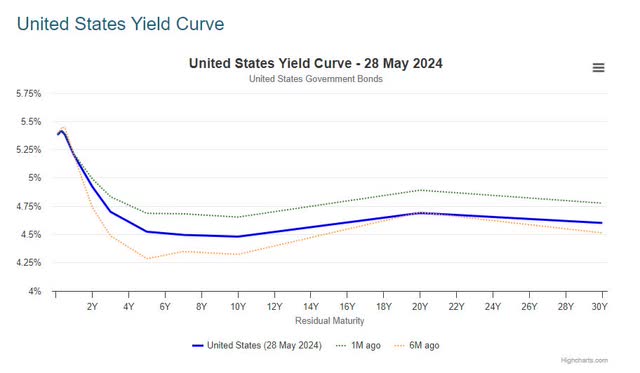
This persistent shape of the yield curve is quite remarkable. It is so counterintuitive to be able to get a higher yield when you’re lending out your money for a shorter period of time, yet here we are. Although, I don’t have a strong conviction on the long end, bills were one of my favorite investment ideas for 2024 and remain so. Primarily because of the high yield in absolute as well as in a relative sense.
My conclusion is that TLTW is at best a hold here. I liked this ETF as a relatively easy way to take advantage of heightened bond volatility. In terms of fees, it comes in at 0.35% per year, which is in-line with the category. It is high for a bond fund, but modest for a strategy that includes an options overlay. Currently, there aren’t the same rich volatility premia to pad results going forward.
It seems quite unlikely, although nothing is impossible, we’ll see a similar 16.61% going forward. Possibly, the realized yield will decline into the single digits. Otherwise, the risk profile is asymmetric against us. I don’t love the long bond position because of the yield curve, but TLTW would rally only marginally anyway because it sells calls. On the other hand, if bonds decline in price, the losses are very similar to an outright long TLT position.
Read the full article here